 mumbaimart.com
Brass Finishers of Girgaum
Girgaum brass finishers polish ceremonial utensils with copper wool and lemon juice, relying on muscle memory and decades of tactile practice.
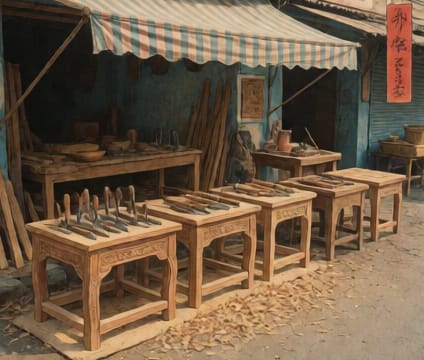
In Girgaum’s narrow alleys, brassware lies under a canopy of sun-filtering tarps, waiting for the final transformation. Finishers sit low on wooden stools, ragged knees resting on fabric pads. They apply lemon juice—sourced fresh daily—to the metal, then rub with copper wool, the motion rhythmic, circular, unbroken. No machines polish here; even electricity is kept off. The brass heats under friction, and the finisher adjusts pressure by feel—light for delicate edges, firm for deep bowls. The metal warms, glows, and brightens with each pass, revealing depth only time can coax.
The copper wool is reused until it frays, then cut into smaller strands for finer work. Lemon juice, mixed in batches with water and a pinch of salt, acts as both cleanser and brightener. Finishers know a good polish by the sound—a smooth, whispering scrape—not by sight alone, especially in the workshop’s uneven light. A mirror finish takes hours, but even the simplest thali gleams with warmth. Tools are simple: bowl, wool, juice, cloth. Skill lies in the hand’s memory of resistance, heat, and sheen.
This finish is never tested—only lived. Each utensil bears the maker’s handprint in subtle variations: a slightly deeper curve where the wrist bent, a smoother rim where the thumb held steady. The goal is not uniformity but integrity—every piece shines as it should, according to its shape and use. Finishers judge their day by the glow, not the clock. When the brass reflects the room sharply, when it feels cool and smooth under the fingertip, the work is done. It is metal made luminous not by chemistry alone, but by care.